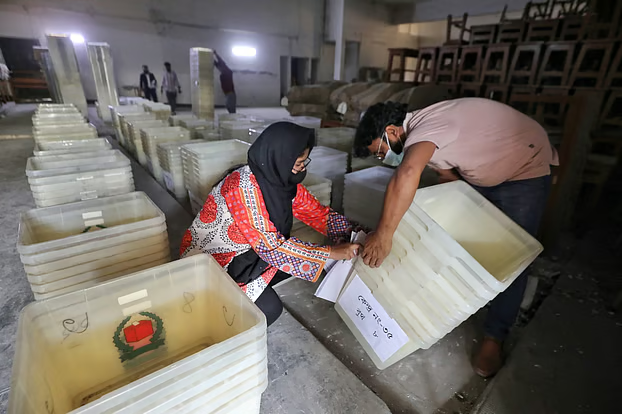
On Thursday, Bangladesh held an acceptable election after 18 years, one in which participation was not curtailed by the state itself. It was not an all-inclusive contest, seeing as the Awami League could not take part in it. However, the circumstances that led to the AL’s absence were of its own making. In the elections of 2014, 2018, and 2024, coercive, manipulative, and strategic tactics employed by the AL kept its rivals largely out of the race. In continuity with that political trajectory, compounded by the July 2024 uprising that led to its ouster, Awami League now finds itself excluded from the process it once controlled.
Despite its absence in this election, AL still retains a significant support base. That may partly explain why the voter turnout did not reach the level many had anticipated, particularly since this election was relatively peaceful compared to the others in recent years. Even though there were some incidents beforehand, on polling day, there were no reports of widespread violence, no major clashes, and no atmosphere of terror. People who wanted to vote were largely able to do so. There were minor complaints, but no major disruptions.
The situation before the election, however, was marked by uncertainty. During Sheikh Hasina’s 15-plus years in power, there had effectively been no credible elections. Under the interim government that was formed following Hasina’s ouster, we witnessed the assertiveness of religious and right-wing hardliners. Over the past year and a half, there have been incidents of vandalism, intimidation, and violence. Women, members of minority communities, and cultural activists felt increasingly vulnerable. Cultural activities such as music, theatre, and folk performances came under attack and declined across the country.
In that context, this election raised a fundamental question about the direction the country would take. Many feared it was heading towards deeper instability. We are now on the verge of getting an elected government and moving away from an unaccountable mode of governance.
Over the last 18 months, the interim administration made several decisions without adequate transparency. Just two days before the election, it signed a trade agreement with the United States that many view as risky for Bangladesh’s future. It also made financial allocation decisions for which no one appears willing to take responsibility. Such opaque decision-making cannot continue. Under an elected government, there must be parliamentary scrutiny and public accountability. A government elected through people’s vote must remain answerable to the people.
However, our experience with past governments that won overwhelming majority in parliament has not been reassuring. In this election, the BNP has secured more than two-thirds majority. We have seen similar moments before. In 2001, the BNP-led alliance won an overwhelming majority. In 2008, the Awami League-led alliance did the same. In both cases, the government’s conduct raised concerns. The BNP-led government took several undemocratic decisions. The Awami League, after 2008, amended the constitution in ways that many believe weakened democratic balance in the country. A large parliamentary majority creates an opportunity for reform, but also the temptation to centralise power and sideline dissent.
We hope history will not repeat itself this time. BNP must reflect on its past. Allegations of extortion, land-grabbing, and political patronage must not resurface. The party must ensure that the minority communities feel secure and long-standing concerns about their safety are addressed. This overwhelming mandate presents a historic opportunity that should not be squandered.