Growing up as Gen Z meant politics was always something we learned second-hand, through a collection of scandals, memes, and news clips we scrolled past on our screens. We debated it, joked about it, and, more often than not, felt powerless before it. For most of our lives, democracy existed as a concept we memorised rather than experienced. It lived inside textbooks, exam answers, and neatly framed quotes pasted on classroom walls. We learned that democracy means government by the people, for the people, of the people, yet for years the very idea of being people felt abstract, distant, almost ceremonial. Decisions happened far above us, campaigns unfolded like theatre, and elections came and went with outcomes that felt pre-decided.
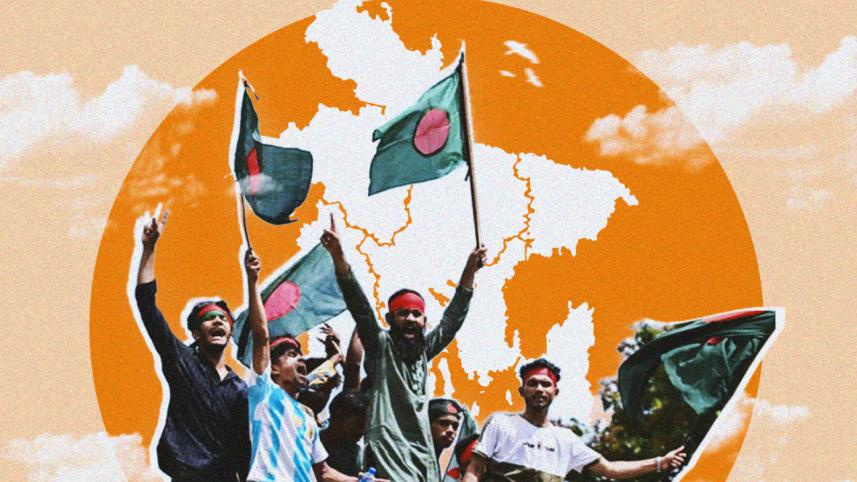
Then July happened, and everything changed. What began as a protest over quotas in public service jobs evolved into a nationwide uprising so seismic it uprooted what felt like an immovable political order. It reminded an entire generation what collective presence looks like. It reminded us that people shape moments, and moments shape systems. As the country moves towards an election, many of us now find ourselves standing at a rare intersection of belief and opportunity.
This election arrives at a time when faith in institutions feels fragile, yet belief in people feels stronger than it has in years. Conversations around voting often carry a familiar scepticism, and it is tempting to ask what one vote can really accomplish. I asked this question myself. However, what this question assumes is that democracy already belongs to others—seasoned politicians, dynastic elites, and powerful brokers—and that we mere spectators are waiting for scraps of influence.
But July taught us that real power does not only live in the hands of those at the top; it emerges when ordinary people claim what belongs to them. Elections gain strength through participation, and turnout transforms a procedural exercise into a meaningful mandate. A crowded polling centre communicates legitimacy in a way speeches never can. One vote multiplied by millions becomes a statement that leaders and institutions listen, that presence has value, and that our generation is ready to participate fully in shaping the life of the country.
For Gen Z, this election holds a different emotional texture. Many of us are voting for the first time in an environment where choice carries substance. We grew up watching politics through screens, filtering reality through satire, outrage, and commentary. We learned early that systems respond to pressure and visibility. We also learned that disengagement creates space for decisions that shape our lives anyway. This election offers us a unique chance to translate awareness into influence and presence into impact. Participation feels less like a duty and more like a claim. A claim that the future we discuss endlessly on social media deserves a presence in the real world too.
We are inheriting a political landscape that reflects both opportunity and urgency. Every policy debate, every budget allocation, every local council decision eventually touches our lives, from education and employment to healthcare and climate action. Being present in an election is the first step in ensuring that these choices reflect the aspirations of a generation that has watched, waited, and now insists on being heard. Voting transforms abstract ideals into concrete accountability, online commentary into offline consequence, and most importantly, frustration into foresight. The act of stepping into a polling booth is both a personal declaration and a collective gesture: it is the generation telling its leaders that the future will not be negotiated in silence.
However, this engagement does not end at the ballot box. The act of voting opens conversations, bridges divides, and builds networks of accountability. It invites us to examine candidates not only through rhetoric but through record, vision, and integrity. It encourages discussions across families, neighbourhoods, and online spaces, enriching the culture of debate and critical thinking. When millions participate, society reaffirms its shared stake in decisions that affect us all.
The strength of a democracy lies not in its institutions alone, but in the collective choice of its citizens. The magnitude of change rests not on single victories or isolated reforms but on consistent, informed participation. Our presence at the polls reminds leaders that legitimacy is earned, not assumed. It encourages accountability, not complacency. It signals that politics is not a spectator sport but a shared responsibility, one that requires courage, curiosity, and commitment. The decisions taken now ripple across generations, shaping opportunities, rights, and freedoms for years to come.
In this light, the simple act of voting transcends ceremony. It is a claim, a dialogue, and a demand for relevance. Each act of participation amplifies the promise of democracy: that governments exist to serve their people and people exist to guide their governments. It transforms hope into action and conversation into consequence.
For Gen Z, voting is a step toward embedding our presence into the very fabric of national life. Years from now, the memory of this day will stay. You will remember the issues you cared about, the conversations you had, and the changes you wanted to see, and you will either remember taking part or wishing you had. Every person who shows up shapes what happens. Showing up is simple, but its consequences last far longer than any online debate, any thread, any post.
So, I have decided that I will vote not for a party, but for the candidate whose vision, integrity, and values feel real to me. I will take the time, stand in line, and cast my vote with intention, knowing it is my small, deliberate claim on the future. I will ask my friends to do the same, because every presence matters. I want to remember this day as one where I showed up and took responsibility for the world I live in. I want to look back and know that I added my voice to the chorus shaping our country, that I did not leave it to others to decide what I and my generation deserve.
Voting will not solve everything, but it is the first step toward a future we can influence. And when years from now I think of this moment, I want it to feel alive in memory, not as a question of what might have been, but as proof that I acted, mattered, and stood, fully present, when the country asked for it.
Maisha Islam Monamee recently graduated from the Institute of Business Administration (IBA) at the University of Dhaka and is a contributor at The Daily Star.