MIAN MUNIR AHMED
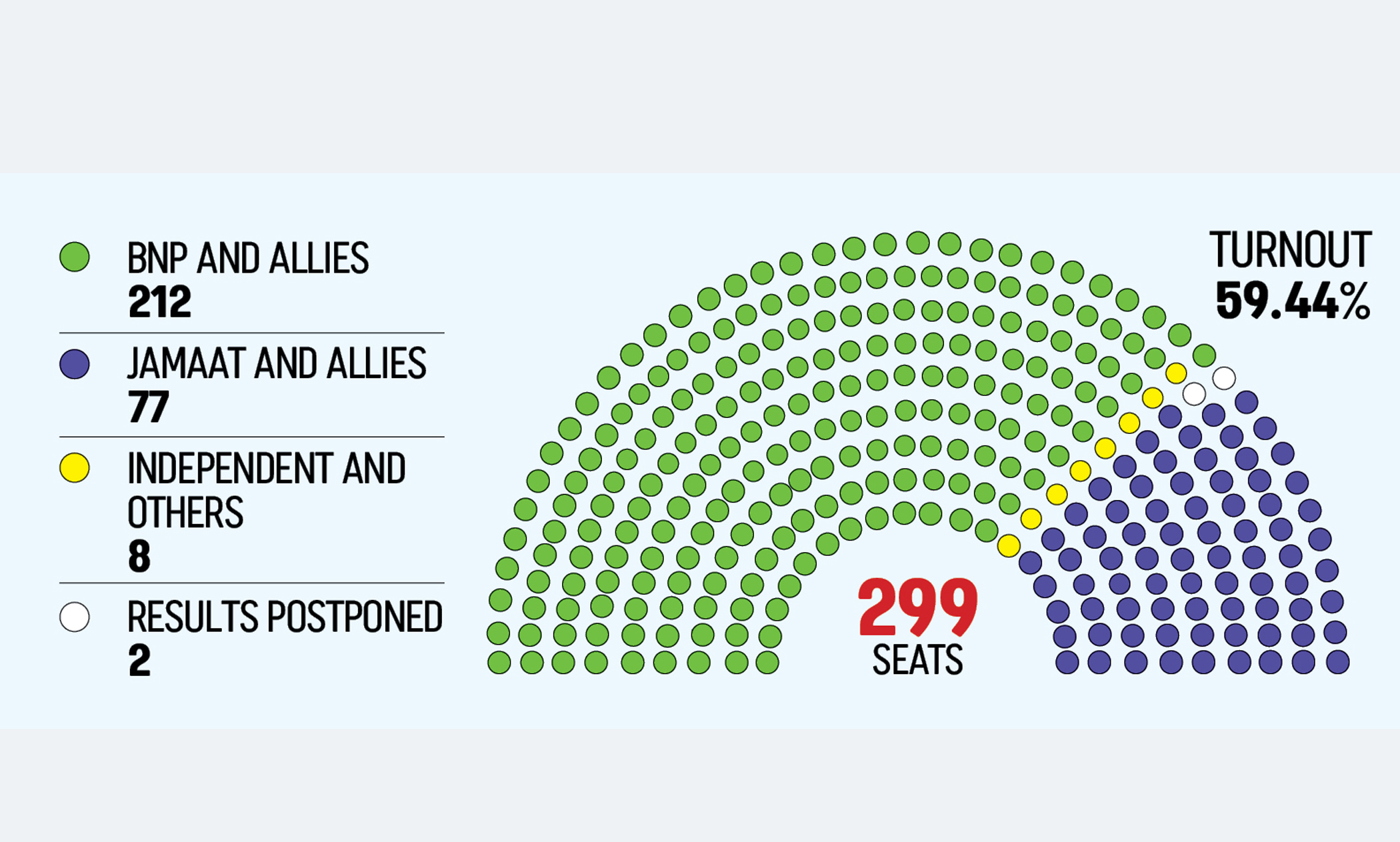
BNP Chairman Tarique Rahman is set to become the next prime minister after his party swept to a stunning landslide in yesterday’s peaceful and festive election, winning more than two-thirds of the parliamentary seats.
The party’s resounding victory, along with Tarique’s wins in two constituencies in his maiden election, marks one of the most significant political comebacks in recent history. It not only restores the BNP to power after two decades but also closes a long, tumultuous chapter of exile and uncertainty for its top leader
Tarique Rahman to a crowd outside his Gul won 209 seats and its alliance partners three, show unofficial results from 297 seats. BNP’s opponent Jamaat-e-Islami and its allies secured 77 seats, according to the Election Commission.
Jailed and later exiled in the UK, the 60‑year‑old returned home last December after more than 17 years to contest, for the first time in his political career, one of Bangladesh’s most consequential elections.
Tarique took over leadership of the party from his mother, former prime minister Khaleda Zia, a giant of Bangladesh politics, 10 days after her death.
From then on, he worked tirelessly to consolidate BNP’s ranks, touring districts with promises of curbing corruption and carrying out electoral reforms and socio-economic development. He mobilised thousands of supporters in what became the most vigorous campaign of his career.
He went on to lead his party to a landslide victory in the 13th national election held 18 months after an unprecedented student‑led uprising toppled the Awami League government.
Tarique’s ascension to the position of prime minister would dismantle the long-standing duopoly that has dominated the country’s political landscape for almost three decades.
However, his climb to the pinnacle of power was anything but easy, shaped by the trauma of his father’s assassination and years of exile, all while facing persistent accusations of corruption and nepotism from his political detractors.
His father, late president Ziaur Rahman who founded BNP in 1978, had been assassinated in a military coup in 1981 when Tarique was a teenager.
Since then, Khaleda led the party which went on to form governments in 1991, 1996 and 2001 under her leadership.
Tarique, who spent his childhood and adolescence in Dhaka, became a member of the Gabtali upazila BNP in Bogura in 1988 at the age of 22. However, he got involved in politics much before he formally joined the party. He took to the streets with his mother during the anti-Ershad movement.
Tarique was made the first joint secretary of the party in June 2002, around a year after the BNP returned to power in 2001 with Khaleda as the prime minister.
Three years later, he convened a countrywide grassroots forum that covered every upazila. He visited all the upazilas, addressed grassroots leaders and activists, and had one-on-one conversations with locals.
It was during this period that Tarique was hit by controversy. He was accused of running “Hawa Bhaban”, an alternative powerhouse of the BNP-led coalition government. He was also accused of using his power to gain personal advantage.
Tarique consistently refuted all the accusations against him.
He was arrested on corruption charges during the tenure of the military-backed caretaker government in 2007. He reportedly endured torture while in custody for 18 months.
Archival news reports from that year said he suffered fractures in the spine and fell sick during multiple court appearances. He was finally granted bail on medical grounds on August 28, 2008, and was released from jail on September 3 that year.
A week later, he left for London with his wife Zubaida Rahman and daughter Zaima Rahman for medical treatment while facing multiple criminal cases at home.
During his exile, he continued to shape BNP’s strategy and policies and served as the party’s acting chairman after his mother was sentenced to prison in 2018.
Meanwhile, he was struck by a personal tragedy. His brother Arafat Rahman Koko passed away in 2015.
Tarique, according to his associates, gradually grew more measured. The years of exile left a mark on him, shaping his idea of greater tolerance in Bangladeshi politics.
He was convicted in absentia in five cases and faced a large number of lawsuits. All charges and the rulings were dropped after the ouster of the AL government, clearing the legal barrier to his return.
Tarique returned home on December 25 last year to an ecstatic welcome. Addressing a massive crowd, he said, “… I have a plan for the people of my country, for my country,” indicating that he was ready to run the country. Thus began the party’s campaign.
To strengthen the party’s position, he attended numerous programmes. He toured the country and held at least 64 public rallies, seeking votes for the party symbol, “Sheaf of Paddy”.
During the campaign, he made over a dozen area-specific pledges, assuring people of job creation, welfare, healthcare, and the development of infrastructure and agriculture. His party also pledged to establish an accountable and “just state” directly answerable to people.
Yesterday, when the election results showed his party’s landslide victory, Tarique expressed gratitude to his supporters for their affection and help in securing the win.
“I am grateful for the love you have shown me. Please pray for me,” he said while talking to a crowd outside his Gulshan residence before leaving for Juma prayers.