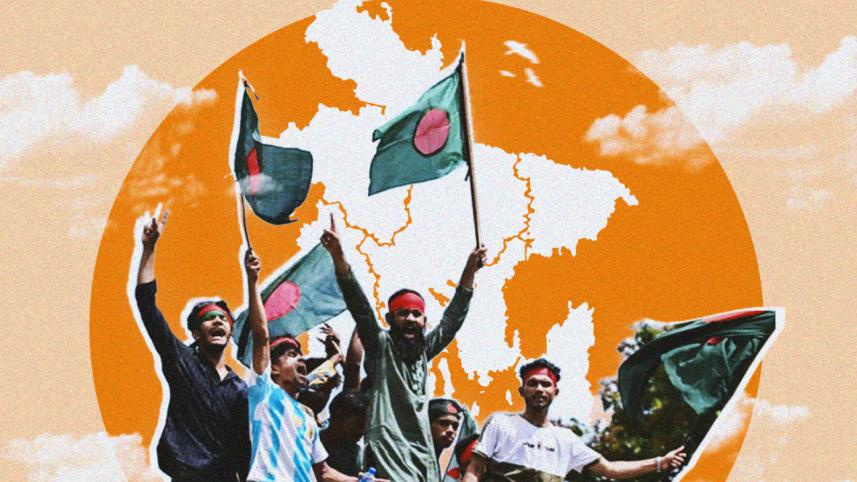
Ahead of the 13th National Parliamentary Election, authorities have deployed a record number of security personnel amid heightened fears of clashes, particularly between supporters of the main contenders – BNP, Jamaat and the NCP.
The government has also intensified joint operations to ensure law and order and public safety, with the army scheduled to remain in the field until February 14.
Around 108,000 members of the armed forces have been deployed nationwide, marking the highest deployment in the country’s electoral history.
This is significantly higher than the 40,000–42,000 personnel deployed in the 2024, 2018, and 2008 elections. In addition, nearly 157,000 police officers are on duty.
Armed forces deployment
Director of Military Operations Directorate (MOD) Brig Gen Dewan Mohammad Monzur Hossain said at a press conference that army personnel have been deployed to ensure a fair and peaceful election environment.
Unlike previous elections, where 40,000–42,000 members acted as striking forces in remote areas, this time army personnel are permitted to patrol directly around polling stations.
Temporary camps have been set up in 62 of the country’s 64 districts, 411 upazilas, and metropolitan cities, totaling 544 camps. Regular patrols, joint operations, and checkpoints have been established to increase surveillance.
“The government, Election Commission, civil administration, law enforcement, and armed forces are coordinated to ensure a free and fair election,” said Brig Gen Monzur.
“The army is ready to take any measures required by law. Deployment numbers are based on a thorough threat assessment.”
Dhaka Metropolitan Police Commissioner Sheikh Md Sajjat Ali said at a press briefing that authorities do not anticipate any violence in the capital.
“There is no security risk surrounding this election or referendum. The law-and-order situation is better than at any other time.”
In total, nearly 900,000 security personnel from various forces are assigned to maintain law and order during the election.
The army, previously deployed nationwide under the “In Aid to Civil Power” mandate, has officially started election-centric duties. The government has also appointed 1,051 executive magistrates to oversee mobile courts, who began fieldwork on February 8.
Shafiqul Alam, press secretary to the chief adviser of the interim government, confirmed that the deployment includes over 37,000 BGB members, more than 3,500 Coast Guard personnel, 157,000 police officers, 567,000 Ansar members, and RAB personnel.
Any complaints or incidents of violence inside or outside polling stations will be reported through the election security app for rapid intervention. Body-worn cameras will also be used.
Election day violence concerns
Although the Awami League is not contesting the election, experts say competition remains intense, particularly between BNP and Jamaat.
Analysts warn that a direct confrontation may occur between supporters of these parties, including party-backed and rebel candidates.
Discussions among the public suggest that no party is likely to back down, raising fears of possible violence.
In recent days, BNP and Jamaat have filed repeated complaints against each other with the Election Commission.
Jamaat-e-Islami accused BNP of spreading propaganda and other violations in polling areas.
On February 8, a team led by Assistant Secretary General Ehsanul Mahbub Zubair submitted complaints to Chief Election Commissioner AMM Nasir Uddin.
Earlier, letters were sent to leaders of Jamaat-e-Islami, Khelafat Majlis, Islami Andolon Bangladesh, and the National Citizen Party warning them against violating electoral rules.
At an election rally in Mohammadpur Central Eidgah on Monday, Bangladesh Khelafat Majlis Ameer Mamunul Haque warned: “The July fighters have not fallen asleep. They are still vigilant. We will prevent all wrongdoing, and no one will dare to snatch the people’s votes.”
Transparency International Bangladesh (TIB) Executive Director Iftekharuzzaman said that while the election began with signs of fair competition, conflicts, unhealthy competition, and violence among parties are gradually increasing.
He emphasized that smooth elections depend on all political parties and candidates following legal procedures.
Experts on security and conflict risks
Former inspector general of Police Abdul Qaiyum told the Dhaka Tribune that the major parties are engaged in a close fight, with threats and personal attacks reported from party leadership to grassroots levels.
He noted that unrecovered looted weapons pose additional risks.
“The government has deployed all its strength to hold the most acceptable election.”
Social and crime expert Dr Tawhidul Haque highlighted ongoing challenges, including the circulation of illegal arms from border areas and the lack of collection of licensed weapons before the election.
He said that record security deployment is necessary because the risk of conflict and violence is highest on election day and in the immediate days after.
He added that the army is now authorized to enter polling centers and exercise magisterial powers.
“The government appears to place greater trust in the army, which is why three times more personnel have been deployed than in the last three elections.”
Risky polling centers
According to police data, 16,359 polling centers nationwide have been identified as risky, while 17,656 are considered general polling centers. In Dhaka, 37 centers are classified as risky.
A Home Ministry circular stated that 16–17 law enforcement personnel will be deployed at general polling centers outside metropolitan areas, and 17–18 at risky centers.
In metropolitan areas, 16 personnel will be assigned to general centers and 17 to risky centers.
In 25 designated remote districts, 16–18 members will be deployed per center, remaining on duty from two days before voting until election day.